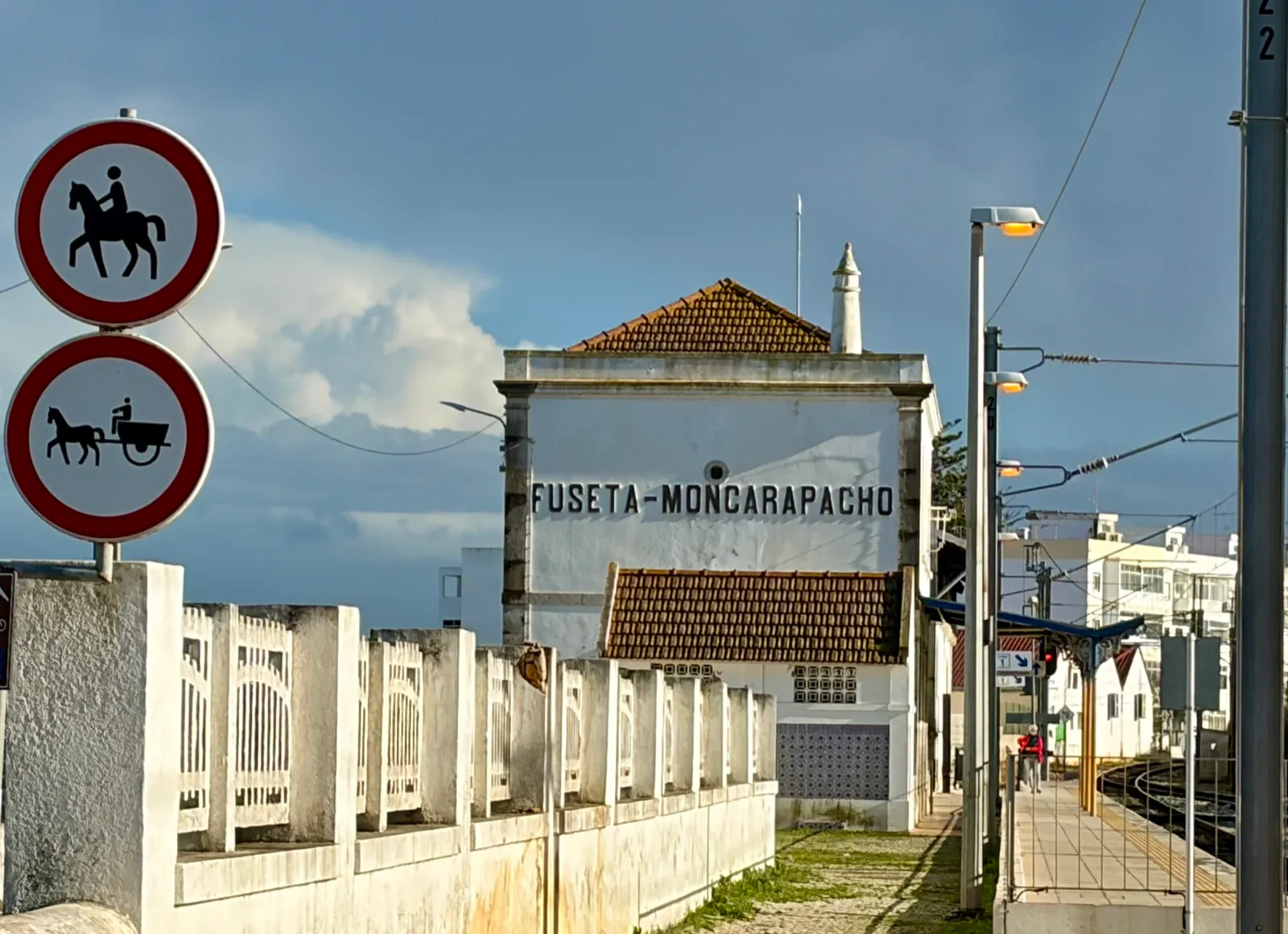
The eastern Algarve makes the choice look harder than it is. Four towns worth basing in, none more than about twenty kilometres apart, all strung along one regional railway that runs a full winter timetable — roughly thirteen services a day each way between Faro and Vila Real de Santo António [source: rome2rio.com].
Which means the towns are not really competing on access. They are competing on what your evenings look like, and on how much town you want between you and the water.
Here is the geography, measured from the station that serves Fuseta and Moncarapacho: Olhão is about ten kilometres away, Tavira about fifteen, Faro about twenty [source: mapcarta.com]. The line from Faro airport reaches that station in roughly thirty-five minutes [source: casa-fuseta.com], first departures from around half six in the morning and last arrivals close to eleven at night [source: moovitapp.com].
That last figure matters more than any of the others, and we will come back to it.
Fuseta: the smallest viable base
Around 2,000 permanent residents, a working harbour, and a lagoon crossing to the barrier-island beach that only operates from March to October [source: algarvetips.com]. In the winter half of the year the Atlantic side of the village is scenery.
What you get is a town at its actual size. The lunch places serve residents, the market is a grocery run rather than an attraction, and the nightlife is Nanobrew, one nanobrewery that opens Friday to Sunday for about four hours and closes at nine. That is not a seasonal reduction — that is the model.
Fuseta is the right base if your evenings are already spoken for, which in practice means you are staying somewhere with other people in it. POMAR na praia sits about ten minutes from the sand here and runs October to April [source: pomar-coliving.com]; the village supports that arrangement well and would not support a solo apartment rental nearly as well. Booked alone in January, Fuseta is very quiet by Tuesday.
Olhão: the working town
More than 45,000 residents, the largest fishing port in the Algarve, and — decisively — no beach of its own [source: algarvetips.com]. Nothing about Olhão was built to be looked at, which is exactly why it holds up across a month.
The market is the argument. Two red-brick halls on the waterfront running six days a week and shutting around one in the afternoon, with a larger outdoor market spilling into the street on Saturdays — one of the biggest fresh-produce markets in the region [source: algarvetips.com] [source: visitolhao.pt]. Through a whole winter it was the fixed point of the week, the thing that made a car unnecessary, and the reason the food budget stopped looking like a holiday.
Base here if you want a town that functions without you — supermarkets, ferries to Armona and Culatra, a waterfront that is a working one. The cost is that Olhão is honestly not pretty in the way its neighbours are, and if that is what you came for you will feel short-changed by week two.
Tavira: the pretty one, and the trade that comes with it
Around 13,000 people in the town itself, more like 25,000 across the municipality, an old bridge over the Gilão estuary and a reputation as the Venice of the Algarve that it did not ask for and cannot shake [source: algarvetips.com].
It is the most agreeable of the four to walk around and the most obviously visitor-facing, which in winter means a proportion of its restaurants are shut while the resident-facing ones stay open. It also holds the best weekend texture on this stretch — the flea market and the street food that goes with it are a genuine reason to spend a Saturday there rather than at home.
Base in Tavira if the town itself is part of what you are buying, and accept a slightly thinner set of everyday options in exchange. From Fuseta it is a short hop on the train, which is arguably the better arrangement: visit it, don’t live in it.
Faro: the only one with a night
Over 60,000 residents, the region’s only international airport, and a university whose students are the reason the city is at its liveliest in autumn and winter rather than in August [source: algarvetips.com]. The bars cluster around the old town and the marina and run year-round [source: algarvetips.com].
If you want to be somewhere that can produce a Thursday night without planning, this is the only candidate on the list. It is also the only one where the airport is walkable-adjacent rather than a taxi decision, which matters if your trip involves flying home for something mid-stay.
The catch is the obvious one: Faro is a small city and you will be living in a city. The lagoon is at the end of the street rather than out of the window, and nothing about the daily rhythm resembles the villages twenty minutes east.
The last train is the actual decision
Everything above rearranges itself around one constraint. Base outside Faro and your evenings there are governed by the timetable — the last regional service back runs late enough to be usable and early enough to end the night for you, and there is no bus fallback worth the name after it.
Which produces the genuinely useful rule for a winter month here. Base in a village and Faro becomes a planned evening, once or twice a month, with the return leg decided before you leave. Base in Faro and the villages become daytime — a Saturday market, a walk, a lunch, back before dark.
Both are good months. They are not the same month, and the mistake is booking the first one while expecting the second.
Who each of these is wrong for
Fuseta is wrong for anybody arriving alone with no built-in social arrangement. Olhão is wrong for anybody who needs their base to be photogenic. Tavira is wrong for anybody who wants a full winter inventory of open restaurants. Faro is wrong for anybody whose reason for coming was to not be in a city.
And all four are wrong for anybody planning around the sea, because in the cold half of the year the sea here is something you look at from a path.