Choose the eastern Algarve over the western half and you are choosing a lagoon over a coastline. That is the whole geographic difference, and in summer it reads as a minor one — both ends of the region deliver sand and water.
In winter it stops being minor. The cliffs and beaches west of Faro are a summer product that goes cold and stays shut. The Ria Formosa is a wetland, and wetlands are at their best in exactly the months everything else here is at its worst.
The catch, and it is a real one, is that the winter lagoon is something you walk beside rather than something you get onto.
What it actually is
The Ria Formosa runs about sixty kilometres of coast from Ancão in the west to Cacela in the east — roughly 18,000 hectares of tidal marsh, channel and salt pan, held off the Atlantic by five barrier islands and two peninsulas [source: formosamar.com] [source: thewildlifediaries.com].
That structure is why the towns here look the way they do. Fuseta, Olhão and Tavira all face inward onto sheltered water with the ocean somewhere out of sight behind a sandbar. The sea is a rumour; the lagoon is the view.
It is also why the walking is flat, endless and slightly monotonous, which if you are working five days a week is a feature rather than a criticism.
Winter is the busy season, just not for people
The lagoon is a wintering ground for birds out of northern and central Europe and a refuelling stop for the ones crossing to Africa [source: formosamar.com]. Over 200 species use it, and greater flamingos show up as winter flocks on the saltmarshes [source: casa-fuseta.com]. One count puts more than 20,000 wintering birds in the system [source: lands.pt].
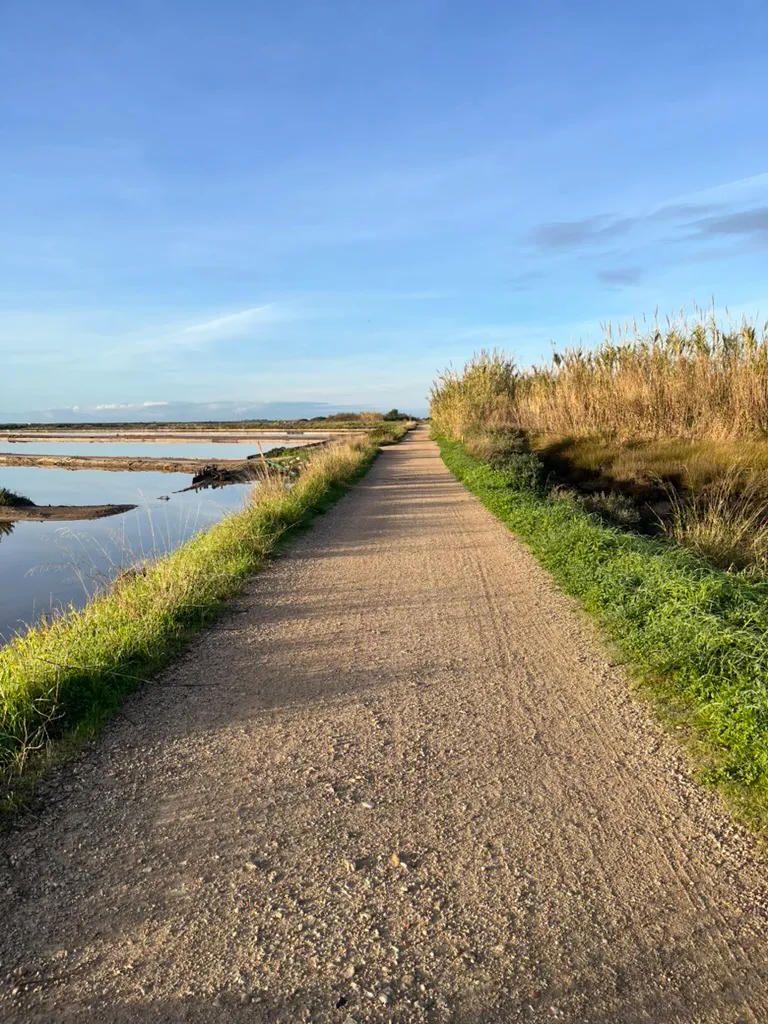
The practical consequence is that in February the salt pans are considerably more populated than the beaches, and that walking a path between two flooded pans at the end of a working day is the closest thing this region has to a reliable winter amenity. It costs nothing, it needs no booking, and it works in the fortnight when it rains every day, because it is a path.
Nobody markets this well, which is the usual signal that it is one of the honest things on offer.
The bit that is genuinely closed
The ferry. Fuseta’s crossing to the barrier-island beach opposite the village runs only from March to October — about ten minutes, €1.80 return, in season [source: algarvetips.com].
Book a stay that starts in January and the island you can see from the harbour wall is not a place you are going. This surprises more arrivals than any other single fact about the region, partly because the island appears in every photograph of the village and partly because ten minutes across the water does not sound like a seasonal service.
Olhão’s ferries to Armona and Culatra are the larger operation on this stretch and the usual suggestion when the Fuseta crossing is off, but winter frequencies are a different question from summer ones and worth confirming against the operator before building a Saturday around them [[verify: Olhão–Armona/Culatra winter timetable]].
Which leaves the mainland shore, and the mainland shore is the point.
What the lagoon is worth from a desk
Working here changes what you want from the water. A summer visitor wants to be on it. A person with calls until six wants something that reliably works in the ninety minutes on either side of the working day, in whatever weather has turned up.
The lagoon delivers that better than the ocean coast does. The paths along the marsh and salt-pan edges are flat, sheltered relative to the Atlantic side, walkable and cyclable, and empty enough in winter that you can go out at seven in the morning and see nobody. From a base in Fuseta — POMAR na praia sits about ten minutes from the sand [source: pomar-coliving.com] — the lagoon edge is the default direction for everything: the run, the ride, the walk that resets an afternoon.
It is also the region’s weather insurance. Wind that makes the open coast unpleasant is survivable behind a sandbar, and the two are half an hour apart.
Where it fails
It is repetitive. Sixty kilometres of the same flat, beautiful, unchanging edge, and after a month you have seen the vocabulary. People who need variety in their outdoors will exhaust this faster than they expect.
It is tidal, which means the view you like is available twice a day and the mudflat version is available the rest of the time. Nothing wrong with the mudflat — the birds are there for a reason — but it is not the postcard.
And it is not swimming. The lagoon in winter is cold, the ocean beyond it is colder, and anyone whose plan involves being in the water rather than beside it has chosen the wrong six months of the year.
Who should choose this coast for it
People who will actually go outside on a Wednesday. The Ria Formosa rewards routine use and gives almost nothing to a weekend visitor, which is the inverse of how the western Algarve works.
Birdwatchers, obviously, and it is worth saying plainly that this is a serious site rather than a pleasant one.
And anybody choosing between the two halves of the Algarve for a winter working month. West of Faro you get better beaches you cannot use. East of it you get a wetland at its annual peak, a flat path network that works in bad weather, and an island you will have to come back in spring to visit.