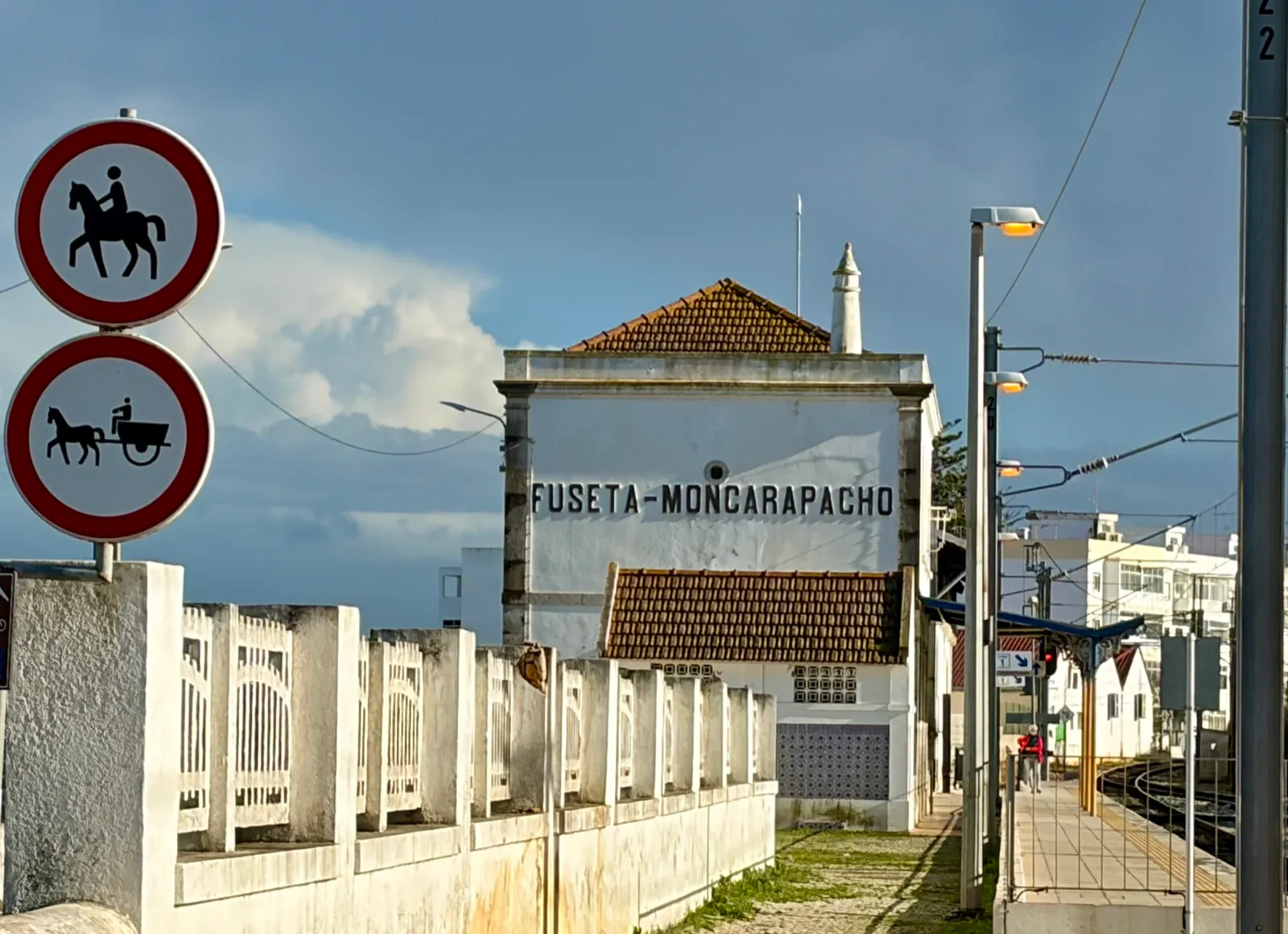
A note on scope before anything else, because the headline promises four weeks and I stayed considerably longer. Four weeks was the block I originally booked at POMAR na praia in Fuseta — the season’s minimum at the time — and it is the honest unit for this question. Four weeks is long enough for the novelty of trains to wear off and short enough that you remember every trip that went badly. I then extended three times and never rented a car at any point, which turns the four-week test into a rather longer one by accident.
The short answer: no, you do not need a car, and the eastern Algarve is unusual in Portugal for that. The useful answer is about where the seams are.
Why this region is the exception
Most of the Algarve’s public transport argument falls apart the moment you leave the coastal strip. Here it doesn’t, for one reason: the railway runs the length of the eastern coast and stops in the villages, not just the towns.
Fuseta has its own station, Fuseta-Moncarapacho, on the regional line between Faro and Vila Real de Santo António. There are roughly thirteen services a day in each direction, and the full end-to-end run takes a bit over an hour [source: rome2rio.com]. Everything a normal week needs sits inside that line. Olhão is about ten kilometres west and Tavira about twelve east — both are single-digit-euro tickets and a journey shorter than the walk to the platform deserves.
That geography is why the house works without a car. The station is in the village. So is the lunch place, the brewery, the market, and the beach. The car question in Fuseta is not “how do I live”, it is “how do I leave on a Saturday”.
What the train actually covers
The Saturday farmers market in Olhão became the fixed point of my week before anything social did — the regional grocery run, done by train, with the market hall open Monday to Saturday from seven in the morning until two [source: algarvetips.com]. It is the single strongest argument against renting: your biggest recurring errand is a short hop on a line that runs all day.
Tavira works the same way. A Sunday flea market and a pizza street party, a group of us on the train, nobody nominated as the driver, everybody able to drink. A car would have made that trip worse, not better.
Faro is where the evening question bites. Getting there for dinner is easy. Getting back from a jam session at Madalena at an hour that respects the last service is not, and the resulting arithmetic — leave early, or stay very late, or split a car — became a recurring feature of Friday nights. That is not a failure of the network. It is the same trade every village in Europe makes.
The bus and the ferry
The bus network exists and is genuinely useful for the inland gaps the railway doesn’t fill — the local Vamus services connect Fuseta with Olhão and Moncarapacho, and there is a Faro–Olhão–Fuseta routing as well [source: algarvebus.info]. In practice I used it rarely: when the train already covers your two main destinations, the bus is what you check after the timetable has let you down.
The ferry is the one to plan around, because it is not there. Fuseta’s crossing to the island beach takes about ten minutes and costs €1.80 return, and it runs only from March until October [source: algarvetips.com]. For a stay that starts in January, the boat is a rumour. Nothing about a rental car changes that — you cannot drive to the island either — but it does remove the one destination people assume a beach village guarantees.
Uber, Bolt, and the direction they work in
Both apps operate in the Algarve, and between them they do most of the work a rental car would have done on the evenings the timetable gives up. The important caveat is that coverage in practice means the bigger towns, the resorts and the airport corridor rather than the whole region [source: wetravelportugal.com] — and Fuseta is a village of about 2,000 people some distance from all three.
That asymmetry is the thing to plan around, and in practice it turned out to run on the day of the week rather than the direction of travel.
Midweek, it worked. Fuseta to Faro meant waiting somewhere between fifteen and thirty minutes for a car, and the return leg came in at much the same — slow enough to notice, quick enough to build an evening around. Friday and Saturday nights are a different service. The drivers are already busy, waits ran past half an hour, and cancellations arrived from both ends: theirs when a closer fare appeared, ours when the wait outlived the reason for the trip.
Rough shape of the money, for the two journeys that matter: the airport into Olhão is a quarter of an hour and around €10, while the airport out to Tavira starts around €30 and has been known to double at peak times [source: algarve-south-portugal.com]. Fuseta sits between the two. Split three ways after a night out, that is roughly the price of the round of drinks that caused it.
The practical habit the house settled into: use the train outbound, the app or a shared taxi back, and — the part people forget — get the number of a local driver early in your stay. In a village this size the reliable option is a person, not a platform.
Where it actually broke
Three times, and they are worth naming precisely because they are the whole cost of the decision.
The Carnival at Loulé. Portugal’s oldest carnival, three days of parades, and the parade itself runs mid-afternoon into early evening [source: theportugalnews.com]. Loulé is inland, west of Faro, and reaching it from Fuseta means a train plus a connection, on a public holiday timetable, returning after the parade has emptied the town onto the same services. Somebody with a car solves this in forty minutes.
Coastal hikes. The weekend walks that made the middle of the stay — the coast west of Faro, the trailheads nobody puts a station next to. Every one of those weekends depended on somebody else in the house having wheels. That is a real dependency, and if you arrive in a quiet week when nobody does, the walk doesn’t happen.
Airport timing. Faro airport is close, and it is also the one journey where a missed connection has a price attached. Early departures and late arrivals are an app or a taxi, not a train — which is survivable in that direction, because the airport is exactly where the drivers are.
Notice what is not on that list: groceries, work, dinner, the beach, the gym, the market, or getting to another town in daylight. The failures are all discretionary weekend trips into the interior.
The compromise most people should make
Don’t rent for the stay. Rent for the weekend you need it, twice.
A month of rental in the eastern Algarve buys you something you will use on perhaps six days, and it comes with parking — which near the Fuseta waterfront is described politely as difficult even off-season [source: algarvetips.com]. Two or three weekend rentals across a four-week stay cost a fraction of that and cover exactly the trips the train can’t.
The other move is a bike, and if you are staying at the house it is already included in the rate along with laundry and housekeeping [source: pomar-coliving.com]. A bike covers the ten-kilometre band the train does not — the salt pans, the coastal track, the villages between stations — and turns the between-town gaps into something you’d choose rather than endure.
Worth knowing before you decide how to pay for any of it: the cost sits differently depending on your contract shape. On a payroll, a rental for personal weekend trips during a remote-work stay is your money and stays your money. Freelance, a car hired to reach a client meeting is arguably a business expense and a car hired to reach a carnival is arguably not, and your accountant will have opinions about the arguably.
Would I do it again
Yes, without hesitating, and I’d budget for two weekend rentals I might not use.
The eastern Algarve is one of the few stretches of southern Europe where the car-free version is not a compromise dressed up as a virtue. The line runs, the villages have stations, and the apps cover the hours it doesn’t. What you give up is the interior — the carnival, the hills, the trailheads — and what you get back is every Friday night in Faro without a designated driver.