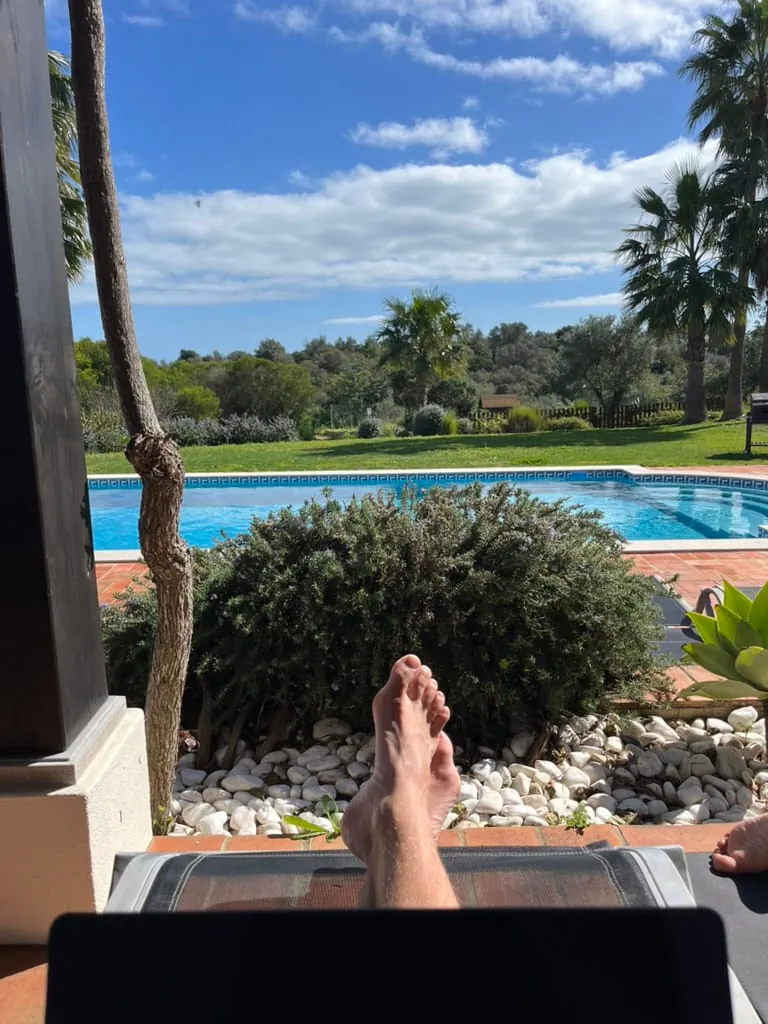
The argument for booking a coliving next to the sea is that the sea does something for you between calls. Salt, wind, a horizon that isn’t a wall. The argument against is that it sits thirty seconds from your desk being permanently more interesting than your inbox.
I spent thirteen weeks testing this at POMAR na praia in Fuseta, across the winter season, and the honest finding is that both arguments are about the wrong thing.
First, a geography correction
The house is in the village and about ten minutes from the sand [source: pomar-coliving.com]. That much is accurate. What “the sand” means is the part nobody clarifies before you book.
Fuseta sits on the Ria Formosa, a lagoon behind a chain of barrier islands. The water at the end of the village is lagoon water — warm, shallow, flat. The Atlantic beach, the one with waves and white sand, is on the island opposite. You get there by a ferry that takes about ten minutes, costs €1.80 return, and runs only from March until October [source: algarvetips.com].
Read that again if you are booking a winter stay, because it does most of the work in this article. For the first two months of my stay the Atlantic was a thing I could see and not a thing I could reach. The house is beach-adjacent. In January it is beach-adjacent in the way a locked museum is art-adjacent.
The version of the claim worth arguing with
Strip the brochure language away and the real claim is this: proximity to water lowers the cost of a break, so you take better ones, so you work better.
That is a testable claim, and it survives — but not for the reason it is usually sold. The lagoon path is a hundred metres of village away. Getting to the water requires no decision, no drive, no parking, no plan. And the thing that ruins a working day is rarely the break itself. It is the twenty minutes of negotiation before the break.
The first three weeks say no
If you had measured my focus in weeks one to three you would have concluded that beach proximity actively harms output.
It didn’t. The weather did. Week two rained on five of seven days, with wind that took the terrace out of use; week three did it again, drier by a hair and windier by more. The terrace — the actual spine of the house’s morning routine — was a wet stone surface behind glass. That story is its own article, but the relevant part here is that the sea was completely irrelevant to it. Nobody is tempted away from a standup by a lagoon in horizontal rain.
Which is the first genuinely useful finding: in the season this house is open, the beach is not competing for your attention for a meaningful share of the stay. Winter does the discipline for you, and charges you in daylight and mood.
The distraction that was real
Something did erode my focus, consistently, and it was not the water. It was the house.
I had picked the quiet room — secluded, off the main circulation, the obvious correct choice on paper. In week five I moved into the loudest room in the building expecting to regret it, and every measure that mattered improved. The pull was never the beach. It was knowing that eleven other people were three metres away having a better afternoon than my calendar was.
That is the real focus tax in any coliving, beach-adjacent or not: a house full of adults who all work for a living, running on EU, UK and US-East hours simultaneously, generates a continuous low hum of things you could be part of instead. Noise, notably, was never the problem — across thirteen weeks with that time-zone spread it never once wrecked a call. Temptation was.
What the water actually did
Here is the pattern that the diary shows, week after week, from week three onward: run in the morning along the Ria, weights in the garden, breakfast on the terrace, work.
The flat lagoon path made a seven o’clock run frictionless, and the run is what made the working day start on time. The pool — heated only on request and for a fee, which is why I was using it as a cold plunge rather than a swim — did the same job at the other end of a workout. Neither of those is “the sea helping you focus”. Both are proximity lowering the activation cost of the habit that structures the day.
So the mechanism is real and the marketing has the causality backwards. The water does not restore you between calls. It makes a morning routine cheap enough that you actually keep it, and the routine restores you.
Who this suits, and who should book inland
It suits you if your work is deep-block work and your failure mode is not starting. A hundred metres of village between you and a flat, empty path at first light is a genuine intervention for that.
It suits you less if your failure mode is finishing — if you are the person who takes the long break and then finds the afternoon gone. The house has a pool, a barbecue area, a volleyball court and mini golf on site, and in the dry stretch at the end of the season those are all quietly available at three in the afternoon. Nothing about the building stops you.
It does not suit you at all if you booked for the Atlantic and are arriving before March. Book a stay in the first half of the season and the ocean is scenery. Book the tail end and you get the ferry, the island and a rising thermal wind, which is a different holiday and a different distraction profile.
One practical note that has nothing to do with focus and everything to do with the decision: the season I stayed ran on a 28-night minimum, and the current published floor is fourteen [source: pomar-coliving.com]. If you are weighing beach proximity against getting anything done, a two-week sample will not tell you. My first three weeks would have produced the wrong verdict. Whatever you conclude in the first fortnight, you are mostly measuring the weather and your own jet-lagged discipline — and if you extend to find out properly, know the cost in advance. On a payroll that is a remote-work agreement with new dates on it that somebody has to countersign; freelance it is a question about whether your pipeline tolerates another month away from where you usually sell. Same deadline, different paperwork.
The verdict
Living next to the Atlantic did not wreck my focus. It also did not deliver the cinematic thing the pitch implies, where you close the laptop, walk into the sea, and return sharpened.
What it did was make the cheap version of self-discipline available every morning at seven, in a village where the alternative activities are a lunch place with three options and a brewery open four hours a week, Friday to Sunday. Fewer competing options, one very easy good habit. That is the entire mechanism, and it is a better reason to book than the postcard is.