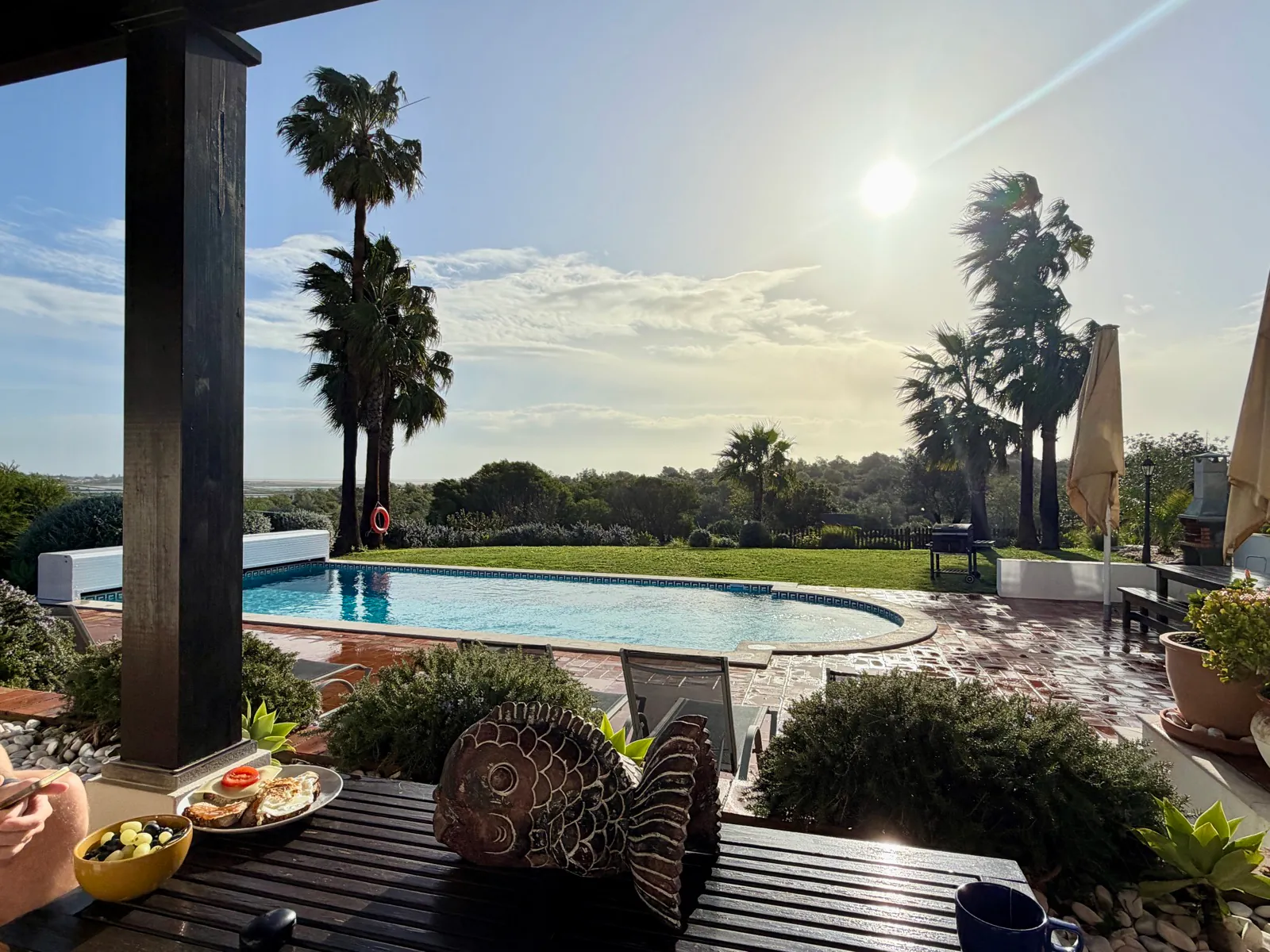
Two stories get told about the Algarve between January and April. One is a booking-site fiction in which Portugal’s national sunshine statistics apply evenly to every month. The other is the expat-forum version in which everything is shut and you will be eating in an empty room lit by one bulb.
The eastern Algarve — Olhão, Fuseta, Tavira, the lagoon towns rather than the resort strip — is neither, and the reason is boring and decisive: people live there year-round. What closes is what was built for visitors. What stays open is what the residents need. Sorting your winter around that distinction is most of the work.
The weather, with actual numbers
Start here, because it is the part that is systematically undersold and the part that will shape your stay.
A thirteen-week stay through the winter season in Fuseta ran, week by week: an opening week dry enough to eat outside every day, then five wet days, then five more, then a wetter one still, then seven consecutive wet days — a full week without a dry one. In two separate weeks the wind was strong enough to cancel plans outright, and in the worst of them it was the only thing anyone discussed.
Then it turned. The middle of the season delivered back-to-back weeks with no rain at all, air that stopped feeling like a wet towel, and closing weeks that ran dry with light winds and long evenings.
That is the honest shape: not “mild and sunny”, not “grim”, but blocky. You get fortnights of Atlantic frontal weather and fortnights that justify the whole trip, and you do not get to choose which one your first two weeks are. Temperatures across it stayed in the range where breakfast outdoors is comfortable and an unheated pool is a cold plunge rather than a swim — mild by northern European standards, cold enough that “poolside” is a photograph rather than a plan.
The relevant comparison is not with the Algarve in June. It is with wherever you would otherwise be in February.
What closes
The ferry. The single most important closure and the one people discover on arrival. Fuseta’s crossing to the barrier-island beach runs only from March until October; in season it takes about ten minutes and costs €1.80 return [source: algarvetips.com]. For a stay that starts in January, the Atlantic beach opposite the village is scenery. The lagoon shore is not, and is walkable throughout.
Beach infrastructure. The concessions, the beach bars, the rental kit and everything downstream of summer footfall. In a village of about 2,000 permanent residents [source: algarvetips.com], the seasonal economy is a large fraction of the visible economy.
The kite season, effectively. Fuseta’s lagoon is a serious flat-water spot, but its working window runs from around mid-March to late October, with the thermal wind building from late winter onwards [source: kitesurftheworld.com]. Winter wind here is frontal weather, not thermal — plentiful and useless.
Some restaurants, in some towns. In Tavira a few tourist-facing places close in the depth of winter, while the ones serving residents stay open — the town’s permanent population makes it far more resilient than the beach resorts to the west [source: algarvefun.com].
And, perversely, some of the colivings — in the other direction. The seasonal houses here run through the winter and shut for summer. POMAR na praia is open October to April [source: pomar-coliving.com], which is precisely why this article exists: the cheap, empty, wet half of the year is the product.
What stays open
The market halls. Olhão’s municipal market runs Monday to Saturday, roughly seven in the morning to two in the afternoon, with the Saturday morning session the big one [source: algarvetips.com]. Through a whole winter stay this was the fixed point of the week — the regional grocery run, unaffected by season, and the thing that made not owning a car viable.
The railway. The regional line along the coast between Faro and Vila Real de Santo António runs a full winter timetable, roughly thirteen services a day each way, stopping at village stations including Fuseta-Moncarapacho [source: rome2rio.com]. Olhão and Tavira are both short hops.
The lunch economy. Delícias da taci in Fuseta runs a daily three-option menu — meat, fish, vegetarian — that changes every day, which is a year-round local operation rather than a seasonal one. Casa Corvo for seafood, Crispim for the unshowy Portuguese version, Madeira Madeira for bread from seven in the morning. None of that is a summer proposition.
The nightlife, at village scale. Nanobrew, the Fuseta craft brewery, opens Friday to Sunday for about four hours, closing at nine [source: instagram.com]. That is not a winter reduction — that is the whole model — and it tells you the real shape of the place. Faro, twenty-odd minutes down the line, carries the actual nightlife.
The birds. Winter is the high season for the Ria Formosa: over 20,000 wintering birds, flamingos and spoonbills on the salt pans, waders on the mudflats [source: lands.pt]. The lagoon is busier in February than the beaches are.
The things that only happen in winter
Carnival is the big one. Loulé runs the oldest continuous pre-Lenten carnival in Portugal — three days of afternoon parades along the main avenue in February, floats, samba schools, the lot [source: theportugalnews.com]. It is inland and west of Faro, so it wants planning if you are car-free; the parade runs mid-afternoon, which is exactly when the return connections thin out.
The smaller version of the same point applies all season: the flea markets, the village markets, the street parties in Faro and Tavira are running for locals in January because locals are still there. You get access to a functioning town rather than a serviced one.
What to expect, honestly
Expect the towns to be open and the sea-facing layer of them to be shut. Expect to be one of very few visitors, and expect the resulting social life to come from wherever you are staying rather than from the town. Expect prices at the bottom of their annual range and availability at the top.
And expect the weather to make the decision for you more often than you would like. Nothing in the paragraph above is much use in a week that rains on all seven days. What survives that week is the market, the train, the lunch place and the people you happen to be living with — which is a short list, and the reason the eastern Algarve rewards a long booking rather than a sampling trip.
Who this is wrong for
Anybody whose plan depends on the sea. The ferry is off, the Atlantic side is cold, and the water sports that make this coast famous are largely out of season.
Anybody who needs a town to entertain them. The eastern Algarve in winter is a place to have a routine, not a place to be shown a good time — and if that sounds like a criticism, it is meant as the opposite. The upside is a working village at its actual size, at a quarter of the summer price, with flamingos in the salt pans and the train still running every hour.