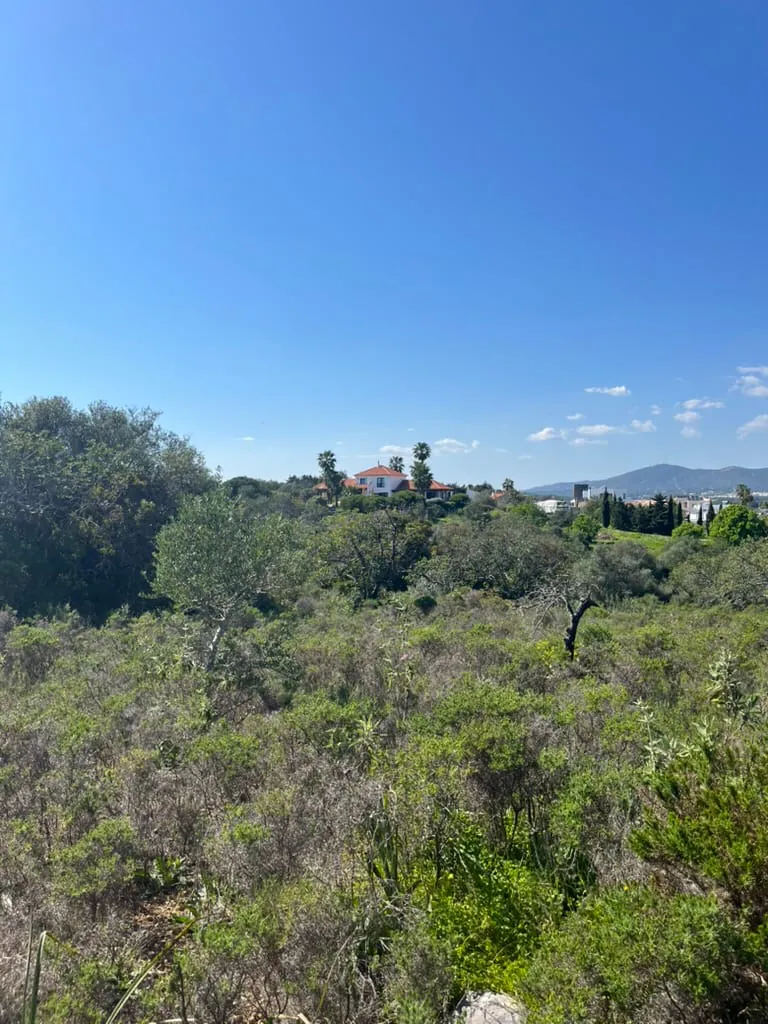
I arrived at POMAR na praia on a Sunday in early January, as the third guest in a house that had opened that same day. I brought a carry-on backpack and a day pack. At the time this felt like discipline. Thirteen weeks later it still mostly held up, which says more about the eastern Algarve than about my packing.
The plan was tidy and slightly smug: work hard, train a bit, and repair the fact that I had let my social life quietly atrophy somewhere around my mid-thirties. What I actually got, for three weeks, was rain, a bed I didn’t sleep especially well in, and a group of people I hadn’t yet decided whether I liked.
Week one lies to you
The first week was almost dry. Across those seven days: one damp morning and nothing after it, cold enough at dawn to want sleeves and warm enough by lunch to lose them, and a wind you noticed only on the exposed stretch of the lagoon path. Breakfast on the terrace every morning. Dinner at Frango da Ria on the first night. Orange and avocado picking on Pomar’s own farm mid-week, which is the kind of sentence that makes people at home hate you.
Then the Atlantic remembered it was January.
Week two: rain on five of seven days, air thick enough that nothing dried indoors, and wind that took the terrace out of use. Week three: wet on five days again — drier by a hair, windier by more. Two solid weeks in which the terrace — the actual spine of the house’s morning routine — was a wet stone surface you looked at through glass.
Nobody writes this part up. The eastern Algarve in January is not the postcard, and Portugal’s national reputation for sunshine is doing a lot of unearned regional work. What I wrote in my notes at the end of each of those weeks, more or less verbatim, was: still better than Germany. Which is true, and also the lowest bar in Europe.
The strange bed
I had picked the quiet room. Secluded, off the main circulation, the obvious correct choice for someone who had come to work. If you had handed me a floor plan I would have picked it again.
For three weeks I slept adequately and lived on the edge of the house. Work weeks ran Monday to Friday like they do anywhere. I’d finish a day, walk out into a building where something had clearly been happening for two hours, and arrive at it late. Not excluded — just consistently one beat behind.
In week five I moved into the loudest room in the building, expecting the worst, and it was better in every way that mattered. That’s a separate piece. But it’s worth flagging here, because it reframes the first three weeks: the sleep wasn’t the problem, and the room I’d have chosen on paper was the room quietly extending the slog.
A group of people I hadn’t decided to like yet
Every Tuesday the house met to plan the week. New arrivals introduced themselves, the community manager laid out what was on — a workout, a skill share, a dinner theme — and the rest of us said what we were up for. It’s the single most load-bearing hour in the week, and for the first three weeks it mostly felt like a meeting.
The programme was not thin. A family dinner of Arroz de Marisco in week one. Portuguese lessons from a local community member in week two. A movie night on the terrace under a pile of blankets, which in a week that wet reads as defiance. A Sunday in Tavira with another coliving’s tribe. Saturday mornings at the Olhão farmers market, which became the fixed point of the week before anything social did.
None of it landed immediately. What I remember is three weeks of low-grade social admin: names, job titles, time zones, the same four opening questions, and the unspoken arithmetic everyone in a coliving is running about whether these are going to be their people. Half the time, honestly, they aren’t. That’s the actual odds, and no operator can fix it.
What turned it
Week three, and I can date it from my own notes. The daily line changes from breakfast, work, lunch, work to running in the morning, working out with weights, breakfast on the terrace, work, lunch, work, dinner, a lot of laughs in between. That last clause appears in week three and then in almost every week after it. It does not appear in weeks one or two.
Three things happened at once. The community manager ran the first proper group workout, which turned a house of individually-training strangers into a thing with a schedule. We hiked the coast west of Faro on the weekend. And Tavira had a flea market and a pizza street party, which is a low bar for a good Saturday and cleared it comfortably.
At the end of week three I extended by four weeks. The weather that week was the worst it had been. I want that on the record, because it means the thing that changed wasn’t the Algarve.
What I’d tell someone booking this
The season I was there sold on a 28-night minimum, and after this stay I thought the minimum was the most honest line on the page. It has since dropped to fourteen [source: pomar-coliving.com], which I understand commercially and would ignore personally. Three weeks is not the stay. Three weeks is the runway. Book two and leave, and you will have paid for the slog and skipped the part it was buying.
Which makes the extension the thing to plan before you go, not during. Give yourself a booked block long enough to get past week three, and know in advance what extending costs you: on an employment contract that’s a conversation about dates and a remote-work agreement your manager has to re-sign; freelance it’s a look at whether the invoice pipeline survives another month away from the desk you usually sell from. Different problem, same deadline — and week three is a bad week to start solving it, because week three is when you’ll want to.
The other thing: pack for weather you don’t believe in. Not a coat and boots — a plan for what you do with a house whose social centre is an outdoor terrace when it rains five days a week. The people who coped best in weeks two and three were the ones who’d stopped waiting for it to clear.
Would I do it again
Yes, and I’d take the same three weeks. Not because they were good — they weren’t, particularly — but because everything I actually came for showed up on the other side of them, and I can’t find a version of the trip where I skip to it. I extended twice more after that first one, and left in April with slightly less in the backpack than I arrived with.
The verdict I wrote at the end of thirteen weeks: people make great experiences, not great locations or perfect buildings. It took three wet weeks in a quiet room to work that out, which in fairness is quicker than it took me at home.